
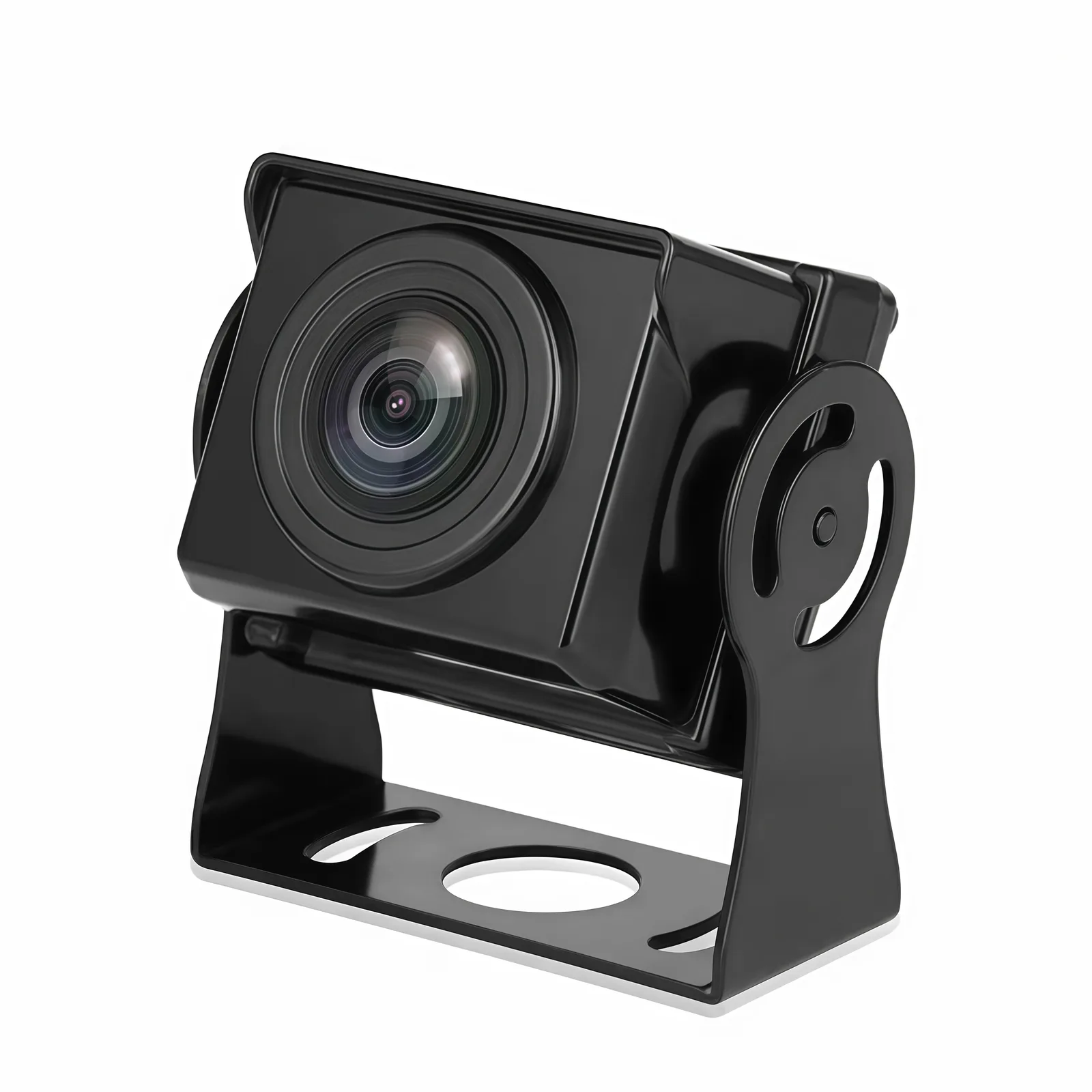
TL;DR
Blind spot detection (BSD) is a safety system that uses radar or camera sensors mounted on a vehicle's sides and rear to monitor the areas a driver cannot see in the mirrors, then triggers a visual or audible warning when another road user enters that zone during a turn or lane change.
Blind spots are the areas around a vehicle that the driver cannot see directly or through the mirrors. On a passenger car they are small, but on a truck, bus or piece of construction machinery they can hide an entire cyclist or pedestrian. Blind spot detection exists to close that gap.
How to understand the way blind spot detection works
A blind spot detection system watches the danger zones continuously and alerts the driver the moment a hazard appears. The typical chain of events is:
- Sensing. Side and rear-mounted sensors — radar, cameras, or both — scan the blind zones several times per second.
- Processing. An onboard processor or AI module analyses the returns. Radar reads range and closing speed; camera systems with computer vision classify whether the object is a person, a cyclist or a vehicle.
- Warning. When something enters the monitored zone, the system raises a staged warning — usually a light in the mirror or A-pillar, escalating to an audible or haptic alert if the driver signals a turn toward the hazard.
On commercial vehicles the near-side (kerb-side) blind spot is the most dangerous, because that is where cyclists and pedestrians travel and where the driver’s sightline is worst. Regulators recognise this: UN Regulation No. 151 (UN R151) defines the Blind Spot Information System (BSIS) test for the near-side of heavy goods vehicles, and the EU General Safety Regulation (Regulation (EU) 2019/2144) has phased BSIS in as mandatory for new heavy vehicle types from 2022 and all new registrations from 2024.
You will also see “blind spot monitoring” used interchangeably with “blind spot detection” — both describe a system that watches the vehicle’s blind zones and warns the driver, while “blind spot information system” (BSIS) is the specific term regulators use for the camera or radar package fitted to heavy goods vehicles. Some cities go further: London, for example, requires a Direct Vision Standard (DVS) permit for HGVs over 12 tonnes, which assesses how much of the surrounding area the driver can see directly and encourages mirror, camera and sensor upgrades where direct vision is poor.
For fleets that already own vehicles, blind spot detection can be added as a retrofit: aftermarket BSD kits mount side cameras or radar sensors and connect to an in-cab display or the existing monitor, so older trucks and buses can be brought up to current safety standards without replacement.
Radar versus camera detection
There are two dominant sensing technologies, and the right choice depends on the operating environment.
- Radar BSD performs reliably in poor weather and darkness and directly measures how fast an object is closing. Its weakness is that it cannot tell a person from a lamp post.
- Camera BSD with AI classifies road users, so it can suppress false alarms from roadside furniture and raise priority warnings for vulnerable road users. It depends on adequate lighting or infrared illumination at night.
Because each technology covers the other’s weakness, many heavy-vehicle systems fuse radar and AI cameras.
Quick reference: radar vs camera BSD
| Attribute | Radar BSD | Camera BSD (AI) |
|---|---|---|
| Detection range | Up to 30 m rear/side | 3–10 m near-zone |
| Works in darkness | Yes | With IR illumination |
| Works in rain/fog | Yes | Reduced |
| Classifies road users | No | Yes (person vs object) |
| Typical refresh rate | 20–50 Hz | 25–30 fps |
| Best mounted at | Rear corners, sides | Kerb-side, A-pillar view |
Benefits of a blind spot detection system for fleets
- Fewer side-swipe and turning collisions: the near-side blind spot is a major factor in truck and bus collisions with cyclists and pedestrians, and a large share of those are on the side the driver cannot see.
- Regulatory compliance with blind spot information system mandates such as Regulation (EU) 2019/2144 and UN R151 in markets that require them.
- Lower insurance and downtime costs, since a single avoided collision typically outweighs the hardware investment.
- Driver confidence, especially for new drivers manoeuvring 12-metre-plus vehicles in dense urban traffic.
Choosing a system for your vehicles
Match the sensor type to your routes, verify that the warning method suits your cab layout, and confirm the system integrates with any recorder or fleet platform you already run. YUNTOR builds BSD cameras and AI detection terminals on self-developed boards, so the sensing, warning and recording layers work together rather than as bolted-on parts.
On the camera side, YUNTOR’s range covers blind-spot detection with dedicated side cameras (X037, X084), panoramic and general vehicle cameras (X099, X901), infrared and reversing cameras in metal housings (X069, X201, X012, X070, X068, X067) — all AHD/analog compatible so they connect to existing displays — and IP network cameras (X-IPC001, X-IPC002) for network recording. On the detection side, the X225 ADAS camera adds forward-collision (FCWS) and lane-departure (LDWS) warnings, and the X066 AI DMS camera monitors driver fatigue and distraction with infrared night vision for low-light cabs.
YUNTOR BSD & detection models at a glance
| Model family | Role | Notes |
|---|---|---|
| X037, X084 | BSD blind-spot detection cameras | Side mounting, AHD-compatible |
| X099, X901 | Panoramic / general vehicle cameras | Multi-angle coverage |
| X069, X201 | Infrared reversing cameras | Metal housings |
| X012, X070 | USB reversing cameras | Plug-in connection |
| X068 | Infrared reversing camera | Wide-angle coverage |
| X067 | Waterproof infrared reversing camera | IP-rated housing |
| X-IPC001, X-IPC002 | IP network cameras (IPC) | Network recording |
| X225 | ADAS active safety camera | FCWS, LDWS warnings |
| X066, X065 | DMS driver fatigue warning cameras | Driver attention monitoring |
| X124, X125 | Mini DMS series | Compact cab mounting |
All of these run on YUNTOR’s self-developed boards and are available at low MOQ with OEM/ODM customization, so a BSD package is matched to the vehicle rather than a generic off-the-shelf unit.
Looking for panoramic & BSD cameras?
Panoramic and blind-spot detection (BSD) cameras reveal the zones a commercial vehicle driver cannot see, from the sides and rear to a full 360° bird’s-eye view. YUNTOR builds them on automotive-grade, wide-temperature housings with AHD output that drops into your existing monitor.